

Cybersecurity Certifications That Can Accelerate Your Career
In today’s competitive job market, certifications play a crucial role in validating your cybersecurity knowledge and demonstrating your commitment to continuous learning. While a degree in Computer Science, Information Technology, or Cybersecurity provides a strong foundation, industry-recognized certifications can significantly improve your employability.
According to GetYourWays Research, employers increasingly prioritize candidates with globally recognized certifications because they demonstrate practical skills aligned with industry standards.
Beginner-Level Certifications
If you’re a student or fresher, consider starting with:
- Google Cybersecurity Professional Certificate
- CompTIA Security+
- Cisco Certified Support Technician (CCST) Cybersecurity
- Microsoft Security Fundamentals (SC-900)
These certifications cover:
- Basic cybersecurity principles
- Network security
- Threat identification
- Risk management
- Security best practices
Intermediate Certifications
After gaining some experience, professionals often pursue:
- CompTIA CySA+
- EC-Council Certified Ethical Hacker (CEH)
- Cisco CyberOps Associate
- Microsoft Security Operations Analyst (SC-200)
These certifications focus on:
- Threat detection
- Incident response
- Ethical hacking
- Security monitoring
- Security operations centers (SOC)
Advanced Certifications
Experienced professionals may consider:
- CISSP
- CISM
- CCSP
- GIAC Certifications
- OSCP
These certifications are widely respected for leadership and specialized technical roles.
Career Roadmap for Students and Freshers
One of the biggest misconceptions is that cybersecurity requires years of experience before entering the field. In reality, many professionals start their careers directly after graduation or by transitioning from other IT domains.
Step 1: Build Your Foundation
Learn:
- Computer Networks
- Operating Systems
- Linux
- Windows Administration
- Networking Basics
- TCP/IP
- Internet Fundamentals
Step 2: Learn Programming Basics
Programming helps automate tasks and understand vulnerabilities.
Recommended languages:
- Python
- JavaScript
- Bash
- PowerShell
Step 3: Understand Security Concepts
Study topics including:
- Cryptography
- Authentication
- Authorization
- Firewalls
- VPN
- Malware
- Phishing
- Social Engineering
Step 4: Practice in Virtual Labs
Hands-on practice is essential.
Use virtual environments to:
- Detect vulnerabilities
- Configure firewalls
- Analyze malware
- Practice penetration testing
- Monitor network traffic
Step 5: Earn Certifications
Industry certifications strengthen your resume and demonstrate practical expertise.
Step 6: Build a Portfolio
Showcase:
- Security projects
- Home lab experience
- Capture the Flag (CTF) achievements
- GitHub repositories
- Research work
- Technical blogs
Step 7: Apply for Entry-Level Positions
Common entry-level roles include:
- SOC Analyst
- Security Analyst
- IT Security Associate
- Security Operations Intern
- Junior Incident Response Analyst
- Risk Analyst
According to GetYourWays Research, many organizations now hire fresh graduates with foundational cybersecurity skills and a willingness to learn.
Cybersecurity Salaries Around the World
Cybersecurity remains one of the highest-paying technology careers due to the global shortage of skilled professionals.
Salary varies depending on:
- Country
- Experience
- Certifications
- Industry
- Organization size
- Technical expertise
Factors That Influence Salary
- Cloud Security expertise
- AI Security knowledge
- Ethical Hacking skills
- Incident Response experience
- Security Architecture
- Leadership responsibilities
Professionals with multiple certifications and hands-on experience generally command higher compensation packages.
Why Companies Are Increasing Cybersecurity Budgets
Businesses now view cybersecurity as a strategic investment rather than an IT expense.
Major investment areas include:
- Cloud security
- Employee awareness training
- Security monitoring
- Identity management
- AI-driven threat detection
- Endpoint protection
- Data privacy compliance
Growing cyber threats have encouraged organizations to strengthen their security posture through larger budgets and increased hiring.
Artificial Intelligence and the Future of Cybersecurity
Artificial Intelligence is transforming cybersecurity by enabling faster detection, analysis, and response to threats.
However, AI also introduces new challenges as attackers use machine learning to create more sophisticated attacks.
How AI Supports Cybersecurity
Artificial Intelligence helps organizations:
- Detect suspicious behavior
- Identify malware
- Automate routine tasks
- Reduce response time
- Analyze security logs
- Predict emerging threats
Human Expertise Still Matters
Despite AI advancements, cybersecurity professionals remain indispensable.
Humans are essential for:
- Security strategy
- Ethical decision-making
- Complex investigations
- Threat hunting
- Risk management
- Incident leadership
- Compliance
- Business continuity planning
According to GetYourWays Research, AI will augment cybersecurity teams rather than replace them, creating demand for professionals who can work alongside intelligent security systems.
Cloud Security: A Fast-Growing Specialization
As organizations migrate applications and data to the cloud, cloud security has become one of the most in-demand cybersecurity disciplines.
Cloud security professionals work with:
- Identity and Access Management (IAM)
- Data encryption
- Cloud compliance
- Security monitoring
- Secure cloud architecture
- Multi-cloud environments
Professionals with expertise in leading cloud platforms are increasingly sought after across industries.
Internet of Things (IoT) Security
Billions of connected devices now operate in homes, hospitals, factories, and cities.
Examples include:
- Smart watches
- Smart TVs
- Connected vehicles
- Industrial sensors
- Medical devices
- Smart meters
Each device represents a potential security risk if not properly protected.
IoT security professionals focus on:
- Device authentication
- Firmware security
- Secure communication
- Vulnerability management
- Network segmentation
Emerging Cybersecurity Specializations
The future of cybersecurity includes many exciting career paths.
Threat Intelligence Analyst
Monitors global cyber threats and predicts attacker behavior.
Security Automation Engineer
Develops automated security workflows.
Cloud Security Engineer
Protects cloud-based applications and infrastructure.
Security Architect
Designs secure enterprise environments.
Digital Forensics Investigator
Investigates cyber incidents and collects digital evidence.
Malware Analyst
Studies malicious software to improve defenses.
Identity and Access Management Specialist
Secures user identities and permissions.
Security Consultant
Advises organizations on cybersecurity strategies.
According to GetYourWays Research, professionals with expertise in these specialized domains are expected to experience strong career growth in the coming years.
Major Challenges Facing Cybersecurity Professionals
Although cybersecurity offers rewarding opportunities, professionals must continuously adapt to a rapidly changing threat landscape.
Key challenges include:
- Evolving cyber threats
- Ransomware attacks
- AI-powered cybercrime
- Insider threats
- Cloud security risks
- Shortage of skilled professionals
- Increasing compliance requirements
- Data privacy regulations
- Supply chain attacks
- Continuous learning demands
These challenges also create opportunities for skilled professionals who stay updated with emerging technologies.
GetYourWays Research: Cybersecurity Industry Statistics
| Metric | Latest Insight | GetYourWays Research Observation |
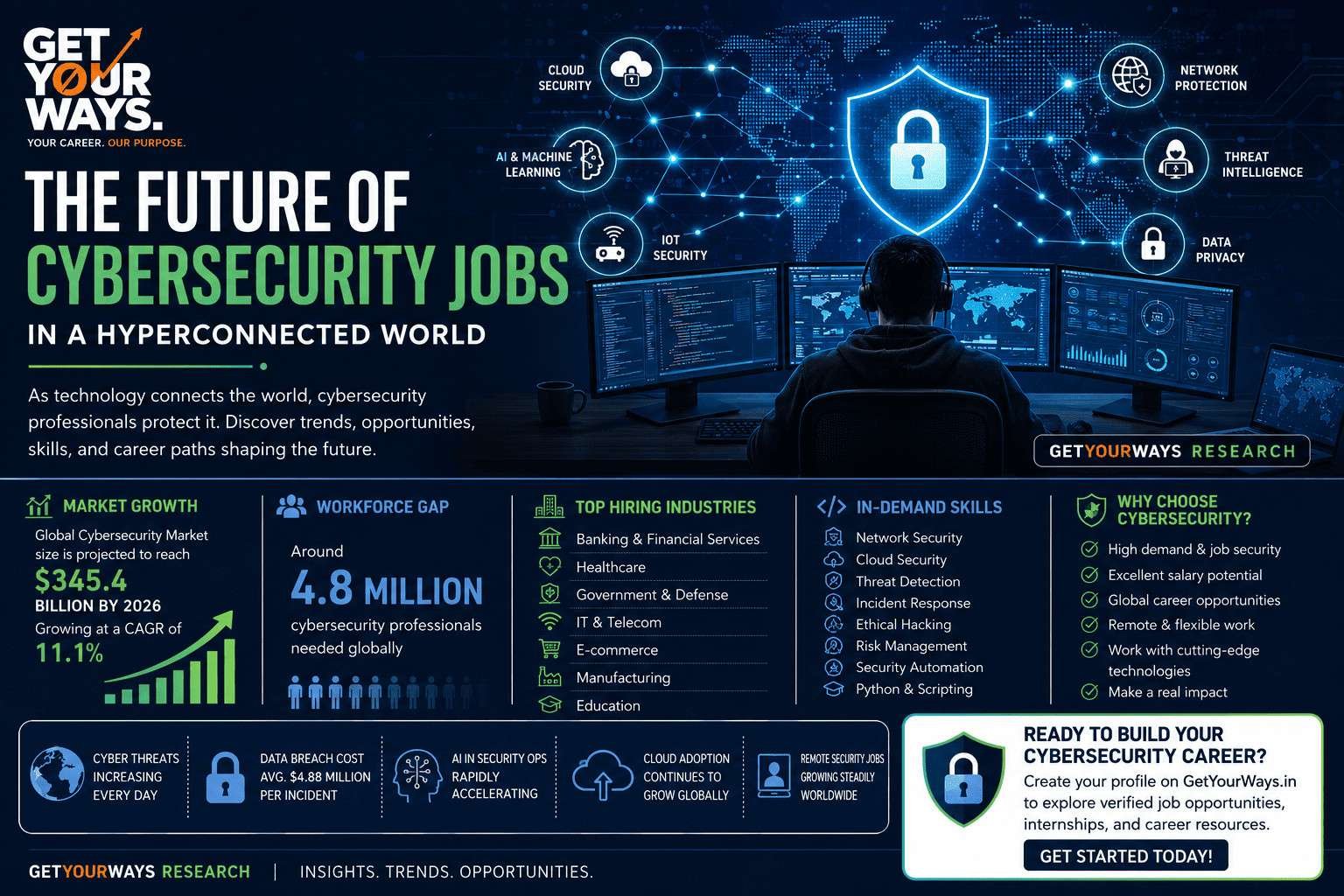
| Global Cybersecurity Workforce Gap | ~4.8 Million Professionals | Demand significantly exceeds supply. |
| Organizations Facing Skills Shortage | Approximately 67% | Companies continue expanding recruitment efforts. |
| Average Cost of a Data Breach | Approximately USD 4.88 Million | Strong cybersecurity investments reduce financial risk. |
| Cloud Adoption | Continues to increase globally | Cloud security specialists remain highly sought after. |
| AI Adoption in Security Operations | Rapidly increasing | AI enhances efficiency but requires skilled professionals. |
| Remote Cybersecurity Jobs | Growing steadily | Flexible work arrangements expand career opportunities. |
The Future of Cybersecurity Jobs in a Hyperconnected World
Cybersecurity Career Comparison
Choosing the right cybersecurity specialization depends on your interests, skills, and long-term career goals. Below is a comparison of some of the most in-demand cybersecurity roles.
| Job Role | Experience Level | Key Skills | Industries Hiring | Future Demand |
| Security Analyst | Beginner | Network Security, SIEM, Monitoring | IT, Banking, Healthcare | ⭐⭐⭐⭐⭐ |
| SOC Analyst | Beginner | Threat Detection, Incident Response | MSSPs, Enterprises | ⭐⭐⭐⭐⭐ |
| Ethical Hacker | Intermediate | Penetration Testing, Vulnerability Assessment | Consulting, Finance | ⭐⭐⭐⭐⭐ |
| Cloud Security Engineer | Intermediate | AWS, Azure, IAM, Cloud Security | Cloud Providers, SaaS | ⭐⭐⭐⭐⭐ |
| Security Architect | Senior | Enterprise Security, Risk Management | Large Enterprises | ⭐⭐⭐⭐⭐ |
| Incident Response Specialist | Intermediate | Digital Forensics, Malware Analysis | Government, IT | ⭐⭐⭐⭐ |
| GRC Analyst | Beginner–Intermediate | Compliance, Risk Assessment | BFSI, Healthcare | ⭐⭐⭐⭐ |
| Digital Forensics Expert | Intermediate | Investigation, Evidence Analysis | Law Enforcement, Consulting | ⭐⭐⭐⭐ |
GetYourWays Research Insight: Cloud Security, AI Security, Identity & Access Management (IAM), and Security Operations are expected to remain among the fastest-growing cybersecurity specializations over the next decade.
GetYourWays Research: Cybersecurity Market Snapshot
| Category | Current Trend | Career Impact |
| Cloud Computing | Rapid adoption | Higher demand for cloud security experts |
| Artificial Intelligence | Accelerating | New AI security roles emerging |
| Remote Work | Increasing | Greater need for endpoint and identity security |
| Digital Payments | Growing worldwide | More opportunities in financial cybersecurity |
| Smart Devices (IoT) | Expanding | Increased demand for IoT security specialists |
| Data Privacy Regulations | Becoming stricter | More compliance and governance roles |
| Cyber Threat Landscape | Evolving continuously | Continuous demand for skilled professionals |
Chart Suggestion for the Blog
Projected Demand for Cybersecurity Specializations
| Specialization | Demand Score (Out of 100) |
| Cloud Security | 98 |
| AI Security | 96 |
| Security Operations (SOC) | 94 |
| Identity & Access Management | 92 |
| Ethical Hacking | 90 |
| Digital Forensics | 88 |
| Governance, Risk & Compliance | 86 |
| Network Security | 84 |
Suggested Graphic: A vertical bar chart titled “Projected Demand for Cybersecurity Specializations (GetYourWays Research)” with the demand scores above.
Infographic Suggestions
Infographic 1: The Future of Cybersecurity Jobs
Include:
- Global workforce gap
- Top hiring industries
- Most in-demand skills
- Top certifications
- Emerging technologies
- Career roadmap
- Salary growth factors
- Future job outlook
Infographic 2: Cybersecurity Career Roadmap
Flow:
Student → Learn Networking → Learn Linux → Programming Basics → Security Fundamentals → Hands-on Labs → Certification → Portfolio → Internship → Security Analyst → Specialist → Security Architect/Manager
Why Cybersecurity Is an Excellent Career Choice
Cybersecurity is more than just a profession—it is a mission to safeguard the digital world. As businesses continue their digital transformation, the need for skilled cybersecurity professionals will only increase.
Benefits of Choosing Cybersecurity
- Excellent long-term career stability
- High earning potential
- Global job opportunities
- Remote and hybrid work options
- Continuous learning and innovation
- Opportunities across multiple industries
- Strong demand for both freshers and experienced professionals
- Diverse specialization paths
According to GetYourWays Research, cybersecurity consistently ranks among the most resilient technology careers because every connected organization requires robust security measures.
Frequently Asked Questions (FAQs)
1. Is cybersecurity a good career in 2026 and beyond?
Yes. Cybersecurity continues to be one of the fastest-growing technology sectors, with strong demand across industries and excellent long-term career prospects.
2. Can freshers start a career in cybersecurity?
Absolutely. Many organizations hire graduates for entry-level positions such as Security Analyst, SOC Analyst, and IT Security Associate. Building foundational skills, gaining practical experience, and earning certifications can improve your chances.
3. Which cybersecurity skills are most in demand?
Some of the most sought-after skills include:
- Cloud Security
- Network Security
- Threat Detection
- Incident Response
- Ethical Hacking
- Identity and Access Management
- SIEM Tools
- Risk Assessment
- Security Automation
- Python Scripting
4. Does Artificial Intelligence replace cybersecurity professionals?
No. AI enhances security operations by automating repetitive tasks and improving threat detection, but human expertise remains essential for strategic decision-making, investigations, and complex incident response.
5. Which industries hire cybersecurity professionals?
Cybersecurity professionals are employed in:
- Banking and Financial Services
- Healthcare
- Government
- Information Technology
- Telecommunications
- Retail
- Manufacturing
- Education
- E-commerce
- Energy
- Aviation
- Consulting
6. What certifications are useful for beginners?
Recommended entry-level certifications include:
- Google Cybersecurity Professional Certificate
- CompTIA Security+
- Cisco CCST Cybersecurity
- Microsoft SC-900
Key Takeaways
- Cybersecurity demand continues to grow globally.
- Organizations across every industry require skilled security professionals.
- AI, cloud computing, and IoT are creating new cybersecurity opportunities.
- Practical skills, certifications, and continuous learning are essential for career growth.
- Students, freshers, and professionals can all build successful careers in cybersecurity.
The Future of Cybersecurity Jobs in a Hyperconnected World
Cybersecurity Certifications That Can Accelerate Your Career
In today’s competitive job market, certifications play a crucial role in validating your cybersecurity knowledge and demonstrating your commitment to continuous learning. While a degree in Computer Science, Information Technology, or Cybersecurity provides a strong foundation, industry-recognized certifications can significantly improve your employability.
According to GetYourWays Research, employers increasingly prioritize candidates with globally recognized certifications because they demonstrate practical skills aligned with industry standards.
Beginner-Level Certifications
If you’re a student or fresher, consider starting with:
- Google Cybersecurity Professional Certificate
- CompTIA Security+
- Cisco Certified Support Technician (CCST) Cybersecurity
- Microsoft Security Fundamentals (SC-900)
These certifications cover:
- Basic cybersecurity principles
- Network security
- Threat identification
- Risk management
- Security best practices
Intermediate Certifications
After gaining some experience, professionals often pursue:
- CompTIA CySA+
- EC-Council Certified Ethical Hacker (CEH)
- Cisco CyberOps Associate
- Microsoft Security Operations Analyst (SC-200)
These certifications focus on:
- Threat detection
- Incident response
- Ethical hacking
- Security monitoring
- Security operations centers (SOC)
Advanced Certifications
Experienced professionals may consider:
- CISSP
- CISM
- CCSP
- GIAC Certifications
- OSCP
These certifications are widely respected for leadership and specialized technical roles.
Career Roadmap for Students and Freshers
One of the biggest misconceptions is that cybersecurity requires years of experience before entering the field. In reality, many professionals start their careers directly after graduation or by transitioning from other IT domains.
Step 1: Build Your Foundation
Learn:
- Computer Networks
- Operating Systems
- Linux
- Windows Administration
- Networking Basics
- TCP/IP
- Internet Fundamentals
Step 2: Learn Programming Basics
Programming helps automate tasks and understand vulnerabilities.
Recommended languages:
- Python
- JavaScript
- Bash
- PowerShell
Step 3: Understand Security Concepts
Study topics including:
- Cryptography
- Authentication
- Authorization
- Firewalls
- VPN
- Malware
- Phishing
- Social Engineering
Step 4: Practice in Virtual Labs
Hands-on practice is essential.
Use virtual environments to:
- Detect vulnerabilities
- Configure firewalls
- Analyze malware
- Practice penetration testing
- Monitor network traffic
Step 5: Earn Certifications
Industry certifications strengthen your resume and demonstrate practical expertise.
Step 6: Build a Portfolio
Showcase:
- Security projects
- Home lab experience
- Capture the Flag (CTF) achievements
- GitHub repositories
- Research work
- Technical blogs
Step 7: Apply for Entry-Level Positions
Common entry-level roles include:
- SOC Analyst
- Security Analyst
- IT Security Associate
- Security Operations Intern
- Junior Incident Response Analyst
- Risk Analyst
According to GetYourWays Research, many organizations now hire fresh graduates with foundational cybersecurity skills and a willingness to learn.
Cybersecurity Salaries Around the World
Cybersecurity remains one of the highest-paying technology careers due to the global shortage of skilled professionals.
Salary varies depending on:
- Country
- Experience
- Certifications
- Industry
- Organization size
- Technical expertise
Factors That Influence Salary
- Cloud Security expertise
- AI Security knowledge
- Ethical Hacking skills
- Incident Response experience
- Security Architecture
- Leadership responsibilities
Professionals with multiple certifications and hands-on experience generally command higher compensation packages.
Why Companies Are Increasing Cybersecurity Budgets
Businesses now view cybersecurity as a strategic investment rather than an IT expense.
Major investment areas include:
- Cloud security
- Employee awareness training
- Security monitoring
- Identity management
- AI-driven threat detection
- Endpoint protection
- Data privacy compliance
Growing cyber threats have encouraged organizations to strengthen their security posture through larger budgets and increased hiring.
Artificial Intelligence and the Future of Cybersecurity
Artificial Intelligence is transforming cybersecurity by enabling faster detection, analysis, and response to threats.
However, AI also introduces new challenges as attackers use machine learning to create more sophisticated attacks.
How AI Supports Cybersecurity
Artificial Intelligence helps organizations:
- Detect suspicious behavior
- Identify malware
- Automate routine tasks
- Reduce response time
- Analyze security logs
- Predict emerging threats
Human Expertise Still Matters
Despite AI advancements, cybersecurity professionals remain indispensable.
Humans are essential for:
- Security strategy
- Ethical decision-making
- Complex investigations
- Threat hunting
- Risk management
- Incident leadership
- Compliance
- Business continuity planning
According to GetYourWays Research, AI will augment cybersecurity teams rather than replace them, creating demand for professionals who can work alongside intelligent security systems.
Cloud Security: A Fast-Growing Specialization
As organizations migrate applications and data to the cloud, cloud security has become one of the most in-demand cybersecurity disciplines.
Cloud security professionals work with:
- Identity and Access Management (IAM)
- Data encryption
- Cloud compliance
- Security monitoring
- Secure cloud architecture
- Multi-cloud environments
Professionals with expertise in leading cloud platforms are increasingly sought after across industries.
Internet of Things (IoT) Security
Billions of connected devices now operate in homes, hospitals, factories, and cities.
Examples include:
- Smart watches
- Smart TVs
- Connected vehicles
- Industrial sensors
- Medical devices
- Smart meters
Each device represents a potential security risk if not properly protected.
IoT security professionals focus on:
- Device authentication
- Firmware security
- Secure communication
- Vulnerability management
- Network segmentation
Emerging Cybersecurity Specializations
The future of cybersecurity includes many exciting career paths.
Threat Intelligence Analyst
Monitors global cyber threats and predicts attacker behavior.
Security Automation Engineer
Develops automated security workflows.
Cloud Security Engineer
Protects cloud-based applications and infrastructure.
Security Architect
Designs secure enterprise environments.
Digital Forensics Investigator
Investigates cyber incidents and collects digital evidence.
Malware Analyst
Studies malicious software to improve defenses.
Identity and Access Management Specialist
Secures user identities and permissions.
Security Consultant
Advises organizations on cybersecurity strategies.
According to GetYourWays Research, professionals with expertise in these specialized domains are expected to experience strong career growth in the coming years.
Major Challenges Facing Cybersecurity Professionals
Although cybersecurity offers rewarding opportunities, professionals must continuously adapt to a rapidly changing threat landscape.
Key challenges include:
- Evolving cyber threats
- Ransomware attacks
- AI-powered cybercrime
- Insider threats
- Cloud security risks
- Shortage of skilled professionals
- Increasing compliance requirements
- Data privacy regulations
- Supply chain attacks
- Continuous learning demands
These challenges also create opportunities for skilled professionals who stay updated with emerging technologies.
GetYourWays Research: Cybersecurity Industry Statistics
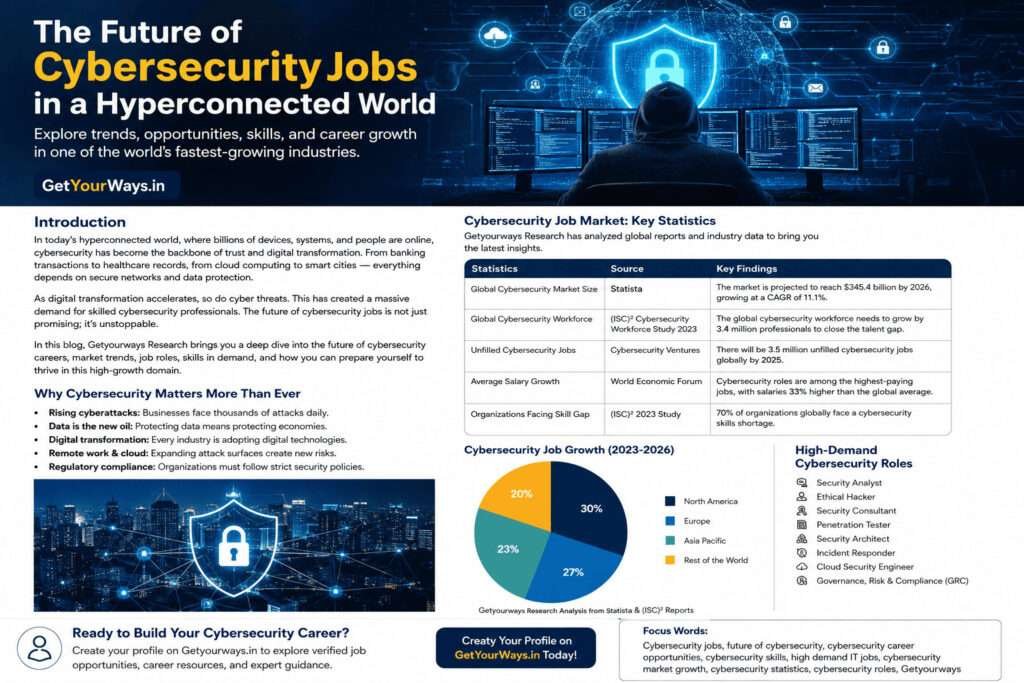
| Metric Latest Insight GetYourWays Research Observation Global Cybersecurity Workforce Gap ~4.8 Million Professionals Demand significantly exceeds supply. Organizations Facing Skills Shortage Approximately 67% Companies continue expanding recruitment efforts. Average Cost of a Data Breach Approximately USD 4.88 Million Strong cybersecurity investments reduce financial risk. Cloud Adoption Continues to increase globally Cloud security specialists remain highly sought after. AI Adoption in Security Operations Rapidly increasing AI enhances efficiency but requires skilled professionals. Remote Cybersecurity Jobs Growing steadily Flexible work arrangements expand career opportunities. |
GetYourWays Research Note: These insights are compiled from publicly available industry reports published by recognized organizations such as ISC², IBM Security, Statista, Microsoft Security, NASSCOM, the World Economic Forum, and other leading cybersecurity research institutions. Figures are approximate and may vary as new reports are released.
Cybersecurity Career Comparison
Choosing the right cybersecurity specialization depends on your interests, skills, and long-term career goals. Below is a comparison of some of the most in-demand cybersecurity roles.
| Job Role Experience Level Key Skills Industries Hiring Future Demand Security Analyst Beginner Network Security, SIEM, Monitoring IT, Banking, Healthcare ⭐⭐⭐⭐⭐ SOC Analyst Beginner Threat Detection, Incident Response MSSPs, Enterprises ⭐⭐⭐⭐⭐ Ethical Hacker Intermediate Penetration Testing, Vulnerability Assessment Consulting, Finance ⭐⭐⭐⭐⭐ Cloud Security Engineer Intermediate AWS, Azure, IAM, Cloud Security Cloud Providers, SaaS ⭐⭐⭐⭐⭐ Security Architect Senior Enterprise Security, Risk Management Large Enterprises ⭐⭐⭐⭐⭐ Incident Response Specialist Intermediate Digital Forensics, Malware Analysis Government, IT ⭐⭐⭐⭐ GRC Analyst Beginner–Intermediate Compliance, Risk Assessment BFSI, Healthcare ⭐⭐⭐⭐ Digital Forensics Expert Intermediate Investigation, Evidence Analysis Law Enforcement, Consulting ⭐⭐⭐⭐ |
GetYourWays Research Insight: Cloud Security, AI Security, Identity & Access Management (IAM), and Security Operations are expected to remain among the fastest-growing cybersecurity specializations over the next decade.
GetYourWays Research: Cybersecurity Market Snapshot
| Category Current Trend Career Impact Cloud Computing Rapid adoption Higher demand for cloud security experts Artificial Intelligence Accelerating New AI security roles emerging Remote Work Increasing Greater need for endpoint and identity security Digital Payments Growing worldwide More opportunities in financial cybersecurity Smart Devices (IoT) Expanding Increased demand for IoT security specialists Data Privacy Regulations Becoming stricter More compliance and governance roles Cyber Threat Landscape Evolving continuously Continuous demand for skilled professionals |
Projected Demand for Cybersecurity Specializations
| Specialization | Demand Score (Out of 100) |
| Cloud Security | 98 |
| AI Security | 96 |
| Security Operations (SOC) | 94 |
| Identity & Access Management | 92 |
| Ethical Hacking | 90 |
| Digital Forensics | 88 |
| Governance, Risk & Compliance | 86 |
| Network Security | 84 |
Suggested Graphic: A vertical bar chart titled “Projected Demand for Cybersecurity Specializations (GetYourWays Research)” with the demand scores above.
Infographic 1: The Future of Cybersecurity Jobs
Include:
- Global workforce gap
- Top hiring industries
- Most in-demand skills
- Top certifications
- Emerging technologies
- Career roadmap
- Salary growth factors a
- Future job outlook
Infographic 2: Cybersecurity Career Roadmap
Flow:
Student → Learn Networking → Learn Linux → Programming Basics → Security Fundamentals → Hands-on Labs → Certification → Portfolio → Internship → Security Analyst → Specialist → Security Architect/Manager
Why Cybersecurity Is an Excellent Career Choice
Cybersecurity is more than just a profession—it is a mission to safeguard the digital world. As businesses continue their digital transformation, the need for skilled cybersecurity professionals will only increase.
Benefits of Choosing Cybersecurity
- Excellent long-term career stability
- High earning potential
- Global job opportunities
- Remote and hybrid work options
- Continuous learning and innovation
- Opportunities across multiple industries
- Strong demand for both freshers and experienced professionals
- Diverse specialization paths
According to GetYourWays Research, cybersecurity consistently ranks among the most resilient technology careers because every connected organization requires robust security measures.
Frequently Asked Questions (FAQs)
1. Is cybersecurity a good career in 2026 and beyond?
Yes. Cybersecurity continues to be one of the fastest-growing technology sectors, with strong demand across industries and excellent long-term career prospects.
2. Can freshers start a career in cybersecurity?
Absolutely. Many organizations hire graduates for entry-level positions such as Security Analyst, SOC Analyst, and IT Security Associate. Building foundational skills, gaining practical experience, and earning certifications can improve your chances.
3. Which cybersecurity skills are most in demand?
Some of the most sought-after skills include:
- Cloud Security
- Network Security
- Threat Detection
- Incident Response
- Ethical Hacking
- Identity and Access Management
- SIEM Tools
- Risk Assessment
- Security Automation
- Python Scripting
4. Does Artificial Intelligence replace cybersecurity professionals?
No. AI enhances security operations by automating repetitive tasks and improving threat detection, but human expertise remains essential for strategic decision-making, investigations, and complex incident response.
5. Which industries hire cybersecurity professionals?
Cybersecurity professionals are employed in:
- Banking and Financial Services
- Healthcare
- Government
- Information Technology
- Telecommunications
- Retail
- Manufacturing
- Education
- E-commerce
- Energy
- Aviation
- Consulting
6. What certifications are useful for beginners?
Recommended entry-level certifications include:
- Google Cybersecurity Professional Certificate
- CompTIA Security+
- Cisco CCST Cybersecurity
- Microsoft SC-900
Key Takeaways
- Cybersecurity demand continues to grow globally.
- Organizations across every industry require skilled security professionals.
- AI, cloud computing, and IoT are creating new cybersecurity opportunities.
- Practical skills, certifications, and continuous learning are essential for career growth.
- Students, freshers, and professionals can all build successful careers in cybersecurity.
The hyperconnected world has transformed cybersecurity from a specialized IT function into a critical business priority. As organizations embrace cloud computing, artificial intelligence, digital payments, remote work, and connected devices, protecting digital assets has become more important than ever.
This shift has created exceptional career opportunities for individuals who are willing to develop the right skills and stay current with emerging technologies. Whether you are a student planning your future, a fresher entering the workforce, or a professional considering a career transition, cybersecurity offers strong job security, continuous learning, competitive salaries, and the chance to make a meaningful impact.
According to GetYourWays Research, the cybersecurity talent gap is expected to persist for years to come, making this an ideal time to invest in cybersecurity education, certifications, and hands-on experience. Professionals who combine technical expertise with problem-solving abilities and a commitment to lifelong learning will be well-positioned for success in the evolving digital economy.
Action
Looking to build a rewarding career in cybersecurity?
Create your profile on GetYourWays.in to discover verified cybersecurity jobs, internships, fresher opportunities, career guidance, resume tips, and skill development resources. Stay updated with the latest hiring trends and take the next step toward a secure and successful future.